Rooms, Waves & Quantum Choices · student series
THE FOUR-FINGER ECHO BOX
Resonance Code · sixteen fingerings · one quantum choice experiment
Pilot candidate · not empirically validated curriculum
MISSION
Use one sound to investigate resonance, learn sixteen fingerings of one four-key acoustic instrument, play a transparent scoring game, and inspect a tiny four-qubit QAOA simulation.
The Echo Box is an ordinary acoustic model. The browser statevector is a classical simulation of QAOA. Measurement returns one four-bit label; only afterwards does that label control the ordinary Echo Box.
Before you begin
One thing I already think I know about resonance
SCREEN 1 · SOURCE
GIVE THE BOX A SOUND
The source waits at the Echo Box inlet. Nothing has passed through the instrument yet.
My source
The core app keeps microphone audio in browser memory. It does not require an account or upload student audio.
Waveform = evidence about the source
Sketch or describe something you notice.
A waveform is ordinary audio data, not the Echo Box and not a quantum state.
SCREEN 2 · REPEATED SYSTEM
HEAR A SYSTEM REMAKE A SOUND
One fixed resonant transformation is applied repeatedly. Output becomes the next input.
| Generation | What I hear | What I see in the spectrum |
|---|---|---|
| 0 | ||
| 2 | ||
| 8 |
This browser transformation is a digital teaching model, not the passive Echo Box and not a recording of a physical room.
LUCIER LINEAGE
Procedure can shape a piece
Reconstruct the idea behind Alvin Lucier's I Am Sitting in a Room.
Number these in order:
__ Play the new recording back into the room
__ Speak / play
__ Repeat
__ Record room + sound
Our new work begins compositionally from Lucier. QAOA does not begin historically from Lucier. A room is not a quantum computer.
What makes the process compositional?
SCREEN 3 · INSTRUMENT
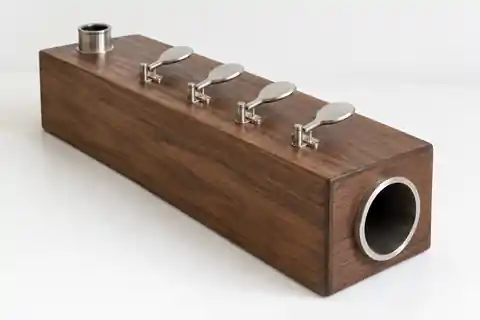
MEET THE FOUR-FINGER ECHO BOX
Learn the four physical keys before treating their states as bits.
OPEN / CLOSED
OPEN / CLOSED
OPEN / CLOSED
OPEN / CLOSED
0 = CLOSED: longer effective path, positive pressure reflection.
1 = OPEN: shorter effective path, pressure-release reflection.
All four branches belong to one coupled acoustic body. Moving a physical key is not a quantum X gate.
ONE INSTRUMENT · SIXTEEN FINGERINGS
Four binary keys give 2⁴ = 16 fingerings
Legend: C = CLOSED = 0 · O = OPEN = 1. These are sixteen fingerings of the same Echo Box, not sixteen separate effects.
The Echo Box defines which acoustic fingerings are possible. The later game defines which of those fingerings it prefers.
SCREEN 4 · LISTENING GAME
CRACK THE RESONANCE CODE
LISTEN → PREDICT → CHANGE ONE KEY → COMMIT → HEAR → REVEAL SCORE
The computer compares shapes of spectral fingerprints rather than simply asking which is louder. Your ears may judge the sounds differently.
Mystery target notes:
The score is a declared game rule, not “true similarity” and not intrinsic musical quality.
YOUR FINGERING TRAIL
Keep a human-game trace
| Move | Before fingering | Predicted key | After fingering | Spectral match | What I heard | |
|---|---|---|---|---|---|---|
| 1 | ||||||
| 2 | ||||||
| 3 | ||||||
| 4 |
Did the declared score agree with your ears?
SCREEN 5 · MODEL HANDOFF
KEEP THE 16 FINGERINGS. CHANGE THE RULES.
The Four-Finger Echo Box remains the acoustic referent. It does not become a quantum computer.
LEFT · ACOUSTIC CHOICE SPACE
Same Echo Box. Same sixteen OPEN/CLOSED fingerings. Same game scores.
RIGHT · QUANTUM MODEL
The same sixteen labels now also name four-qubit computational-basis outcomes, initially 6.25% each.
The invalid fade acts only here.
If lower-scoring quantum bars are simply faded without probability moving elsewhere, total probability falls below 100%. This is not a valid closed quantum state.
Reset means: reset the quantum bars only. It does not reset, discard or replace the Echo Box, its fingerings or the earlier game scores.
SCREEN 6 · COST
COST: WRITE THE SCORE INTO PHASE
The four silver-key pattern stays still. COST acts only on the simulated quantum state.
Immediately after COST, do the computational-basis probability bars move?
After reveal: every bar should still be 6.25%. What changed?
COST writes information from the objective score into relative phase. It does not directly move the computational-basis probability bars or any Echo Box key.
SCREEN 7 · MIX
MIX: LET PHASE DIFFERENCES MATTER
| Experiment | Prediction | Observation |
|---|---|---|
| MIX only from uniform start | ||
| COST only | ||
| COST → MIX |
Canonical MIX mathematically couples labels that differ in exactly one bit. The matching key position helps index the bit; no resonator key is moving. MIX is not a random shuffle or a classical neighbouring-state search.
After COST creates relative phase differences, coupled amplitudes can interfere and probabilities can change. Redistribution is not guaranteed to improve the objective.
SCREEN 8 · BEFORE MEASUREMENT
READ THE QUANTUM DISTRIBUTION
EXACT CLASSICAL STATEVECTOR SIMULATION · NOT QUANTUM HARDWARE
The browser calculates sixteen complex amplitudes for four qubits.
γ = π
β = π/6
A small classical search may choose γ and β for this tiny instance, then the browser simulates the p=1 circuit.
The sixteen bars are quantum measurement probabilities. They are not sixteen audio signals and they do not drive the Echo Box. The ordinary instrument remains inactive/reference-only.
What changed between the uniform distribution and COST→MIX?
SCREEN 8 · MEASUREMENT
MEASURE → SET THE BOX → HEAR IT
| Question | Four-bit label |
|---|---|
| Highest objective score | ____ |
| Highest probability | ____ |
| Actually measured | ____ |
Measurement samples one label from the calculated distribution. It need not return the highest-scoring state, the most probable state, or the same state repeatedly.
The Echo Box did not perform QAOA. QAOA did not filter the audio. The measured four-bit label is used afterwards as an ordinary classical control setting.
Repeat measurement. What stayed the same? What could change?
COMPARE
Your fingering path vs QAOA's distribution + sample
YOUR PATH
final fingering: ____
One decision path through one-key changes to real Echo Box settings.
QAOA
sample: ____
A full simulated quantum probability distribution followed by one measurement sample.
One similarity
One important difference
This is not a human-versus-quantum competition and makes no quantum-advantage claim.
SCREEN 9 · COMPOSITION
MAKE A PIECE FROM FINGERINGS AND CHOICES
Use the same four-key diagrams as a compact fingering score. Only actual human-selected or measured Echo Box labels belong in the acoustic segments.
Where do Lucier/acoustics and QAOA connect compositionally?
Where does the analogy stop physically?
CONCEPT CHECK
Explain the mechanism in your own words
- How many fingerings do four binary Echo Box keys give?
- What defines what counts as preferable: the Echo Box or the game/task?
- What changes immediately after COST?
- Does COST alone move the probability bars?
- What labels does the canonical MIX Hamiltonian couple?
- Is COST→MIX redistribution guaranteed to improve the objective?
- What does measurement return?
- How does the returned label cause one Echo Box fingering to be heard?
COST writes objective information into relative phase. MIX coherently couples one-bit-different configurations, so those phase differences can affect measurement probabilities through interference. Measurement selects one configuration, which is then used as an ordinary classical control setting for the Echo Box.
Educational effectiveness, auditory discriminability, score validity, four-qubit cognitive manageability and parameter policy still require learner testing.
Rooms, Waves & Quantum Choices · pilot series